Larry Moore
SUPPLY LIST for XL Abstraction workshop
Questions?: larry@larrymoorestudios.com
Or text me at 407-222-8585
Don’t freak out at this list; you probably already have 86% of this stuff.
I’m covering all mediums and surfaces in one list. Bring your preferred stuff.
Here’s an abbreviated version of what’s below for the established painters (but you still have to read all of it)
• Pencils, charcoal, note or sketchbook
• The medium (oil or acrylic) colors, and painting mediums/thinner you usually use. Bigger tubes/extra white, tube grays are a plus
• Large palette, paper towels, thinner jar/can
• A wide variety of brushes and cheap mark-making tools (see pdf)
• Bring the painting surface you prefer: 8 20x20-ish, 1 or 2 larger up to 36” for last day (get the inexpensive stuff)
• ½” white artist or masking tape
• They have easels and some 18x24 backing boards for paper or loose canvas
• Open mind and a free spirit
Warehouse 521’s easels can take larger sizes but I wouldn’t suggest going bigger than 36” on the last day.
Warehouse 521 has some rigid boards that can handle 18x24 sheets, if you are working on paper or unstretched canvas, but bring your own drawing board if you prefer. Going larger? you’ll need to bring your own backing board.
For this class, you work in the wet medium and the surface of your choice.
The first 2 days will be spent doing midsize exploratory line and color/shape exercises. The second half of the class can be up to (30x30 to 36x40). But we have to warm up to the ideas first. You can work on or with whatever you are familiar with.
What you will want to bring:
•Sketchbook or notebook and writing utensil
• 2b or 8B pencil, charcoal for interesting marks, just bring what you have already
•Roll of ½” white artist or similar. The blue stuff is passable but not ideal for paper.
•Bring your usual color/pigment palette with some grays & extra amounts of white but if you need a recommendation, here it is:
• Larger mixing surface to handle more pigment. (no little plastic watercolor trays or paper plates)
• Two rolls of paper towels
• Oil, Acrylic your choice: Larry recommends Acrylic for this workshop due to quick drying time and ease of clean up…but the choice is yours!
A basic set of split-primaries @ 2 reds, 2 yellows, 2 blues), + white, black, grays, & a few earth tones. (see list below)
Suggested brands for oils: Grumbacher, Winsor-Newton, Gamblin, whatever your preference or whatever you have.
Acrylic
Suggested brands for acrylic: Golden or Liquitex.
Liquid acrylics are a nice addition to tube acrylic, very optional
Bring enough paint for 10 or so small/medium pieces and 1 or 2 larger paintings (see surface list below)
•Titanium White (2 tubes or largest tube)
For acrylic, I often use gesso as my white to provide more flow. Bring some if you want to try it.
This is not a mandatory color palette, just bring a good range:
•Cad yellow light or lemon
•Cad yellow medium or yellow ochre
•Cad red light
•Alizarin or similar
•Ultramarine blue
•Prussian blue
•Burnt sienna
•Gray(s)*
•Black
•Earth colors like yellow ochre, burnt sienna, asphaltum, etc)
*Gray(s), tints, and earth colors like burnt umber or dioxazine purple, or radiants, and whatever you want to bring are great additions. If you have favorite pigments, bring them.
Bring a decent range of warms/cools/neutrals.
Painting Mediums:
Mediums alter the flow, transparency, and dry times. Very handy for a variety of effects that you can’t get otherwise.
•Mediums for oil:
Cold wax (thick additive, dries fast) optional.
Artists painting medium for oil by Galkyd* or Gamblin solvent free gel to alter viscosity, speeds drying, glazing optional.
*I use Galkyd a lot
•Thinner for oil: Gamsol,or you can go thinner-free and just use Artists medium or linseed oil. No smelly stuff like Lavender oil (sorry-namaste)
For acrylic: Golden satin glazing liquid, heavy gel medium alters viscosities (optional but a nice add)
• Can or container to hold thinners and mediums.
…………………….
Tools
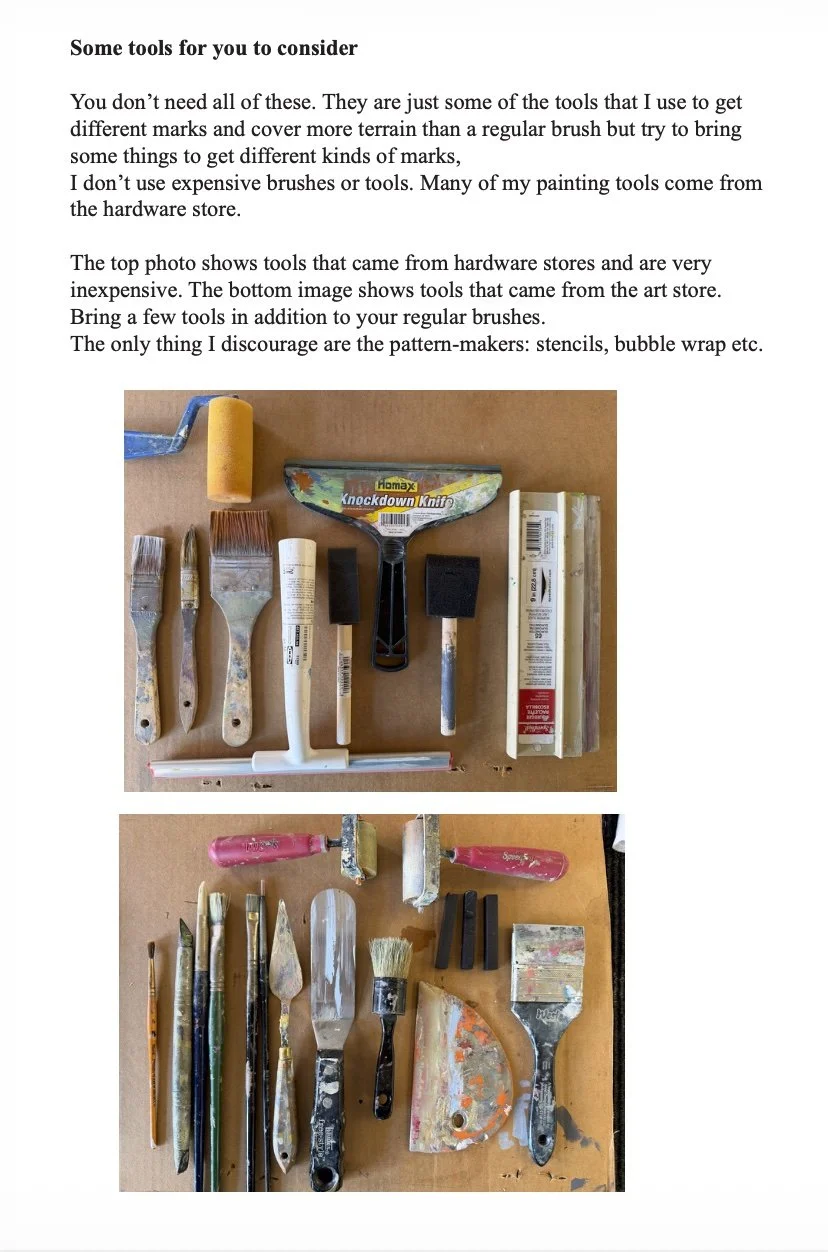
A variety pack of tools is a variety pack of mark and edge options (see pics in file marked Pics below)
•Palette Knife(s) (angled, tapered tip) larger knives for bigger canvases, mixing n scraping
Tools: Rubber-bladed knives for smearing, scraping, and interesting marks
I’m including a pic of my fave tools… don’t go buy them all, be inventive. Variety is good. Go to your local hardware store.
•Palette: You will need an adequate mixing space for more paint. No small plastic daisy-shaped palettes or paper plates…. Or you shall be banished.
A cheap favorite is the flat deli tray with slightly raised edges from Publix deli $4
•Brushes:
For small studies, bring a mix of used smaller synthetic flats and rounds. Don’t bring expensive stuff. Sizes 2-12 flats and filberts.
If you have to buy, buy cheap.
For larger stuff, bristles are great –Augment with synthetic house paint brushes, $2 chip brushes from the hardware store, or cheaper synthetic flats.
Synthetics are optimal for cleaner edges and lines.
• Other optional but recommended tools: oil bars, foam brushes, brayers, spreaders, and squeegees, Homax knockdown knife (on Amazon) come in very handy. Anything that can make a mark, just a few, not all. See pics.
There are no magic brushes. Big canvases need big brushes.
Surfaces
Surfaces for Days 1 and 2
4 mid-size surfaces (we may overpaint as we go because… layers)
20x20-ish stretched canvases or gesso’d panels, or canvas roll. Or heavy watercolor sheets or cardboard or whatever you like to paint on.
Don’t bring the expensive stuff.
Surfaces for Day 3
3 or 4 mid-size surfaces (we may also be overpainting days 1 and 2)
For Acrylic/oil: 20x20-ish canvases or gesso’d panels, or stretched, or canvas roll. Or heavy watercolor sheets or cardboard or anything you can paint on.
Arches oil paper is awesome, Cold press min 140lb. I love gesso’d wood cradled art boxes
•Canvas(es) for Day 4:
1 or 2 larger canvases: Personally, I wouldn’t go past 36x36. Up to you.
If you want a lot of flexibility on size, bring a roll of canvas, like 36”x 6 yards acrylic primed canvas and scissors. And a board to tape them to. (roll canvas optional)
Other stuff:
•Paper towels (viva) or lots of good painting rags
•Open mind and a sense of humor 4